Really cool a van or parked car
$1,269 at Renewable Outdoors, read 2026-09-21
Why this one
A battery compressor sized for van/tent spaces — the honest "car AC" for van life. Runs off its own battery, vents out a window.
There is no cheap 12V portable air conditioner for a car. The accessory socket runs a fan, not a compressor. What cools a parked car: a battery AC that vents out a window, or a personal evaporative cooler in dry air.
Some links pay us a commission, at no cost to you. As an Amazon Associate, we earn from qualifying purchases. How we earn.
Really cool a van or parked car
$1,269 at Renewable Outdoors, read 2026-09-21
A battery compressor sized for van/tent spaces — the honest "car AC" for van life. Runs off its own battery, vents out a window.
Personal cooling on a dry drive
$72 at Evapolar, read 2026-09-21
Runs off USB power and cools the air right in front of you — but only in dry air, and it adds humidity.
The honest physics first. Refrigerating a car's cabin — actually dropping the temperature — takes a compressor, and a compressor draws far more power than a vehicle's 12V accessory socket is fused to deliver. That socket is sized for a phone charger, a dash cam, a small fan. It cannot run a real air conditioner, full stop.
So the cheap "12V AC" units sold online are, almost always, one of these:
Neither is an air conditioner. The genuine ways to cool a car are the same battery-and-venting story as camping: a battery compressor AC that carries its own power and vents a hot duct out the window, or a power station running a small unit. We don't stock a "real 12V car AC" recommendation because, honestly, one that works doesn't exist — and we'd rather say that than sell you a mister with a big word on the box.
Three real tools, matched to how you're using the vehicle. Prices are snapshots on the dates shown — confirm the live price before buying.
| Model | Type | Cooling | Coverage | Weight | Price | Where to buy |
|---|---|---|---|---|---|---|
| EcoFlow WAVE 3 | Battery compressor — vented | 6,100 BTU | — | 33.7 lb | $849 at EcoFlow, read 2026-09-21 | |
| Zero Breeze Mark 3 | Battery compressor — dual-hose | 5,280 BTU | 100–150 sq ft (tent/van) | ~22 lb (unit) | $1,269 at Renewable Outdoors, read 2026-09-21 | |
| Evapolar evaCHILL (EV-500) | Evaporative — truly hose-free | 340–1,190 BTU/hr | 21–27 sq ft, directly in front | — | $72 at Evapolar, read 2026-09-21 |
None of these runs off the car's 12V socket for real cooling: the compressor units carry their own battery, and the evaCHILL is a USB personal cooler, not a cabin AC.
The recurring answer is a portable power station — a large LiFePO4 battery with a proper inverter — not the dashboard socket. It's how van-lifers run a battery AC overnight without draining the starter battery, and it recharges from shore power, solar, or the car's alternator while driving.
The honest limit, again: we won't publish a runtime in hours, because it depends on cabin temperature, the setting and the battery's age, and any single number would mislead. Match the station's capacity and output against the AC's rated draw on its spec sheet, and treat online "runs all night" claims with suspicion.
| Model | Battery | Output | Expandable | Price | Where to buy |
|---|---|---|---|---|---|
| EcoFlow DELTA 3 | 1,024 Wh LiFePO4 | 1,800 W (3,600 W surge) | 1–5 kWh with extra batteries | $599 at EcoFlow, read 2026-09-21 | |
| BLUETTI AC180 | 1,152 Wh LiFePO4 | 1,800 W (2,700 W surge) | No — fixed 1,152 Wh | $499 at BLUETTI, read 2026-09-21 | |
| ALLPOWERS S2000 Pro | 1,451 Wh | 2,400 W pure sine | No — no expansion battery offered | $664 at ALLPOWERS, read 2026-09-21 | |
| EcoFlow DELTA 3 Max | 2,048 Wh LiFePO4 | 2,400 W | Up to 10,240 Wh | $879 at EcoFlow, read 2026-09-21 | |
| BLUETTI AC200L | 2,048 Wh LiFePO4 | 2,400 W (3,600 W surge) | Up to 8,192 Wh with B300 batteries | $899 at BLUETTI, read 2026-09-21 |
BLUETTI's AC180 undercuts the EcoFlow DELTA 3 on price and capacity but is a sealed unit; the DELTA 3 is the pick if you want to add battery capacity later. The ALLPOWERS S2000 Pro splits the difference — 1,451 Wh with full 2,400 W output at a mid-tier price, though like the AC180 it has no expansion option. At the top, the AC200L and DELTA 3 Max are near-identical on paper and both expand for longer trips. Capacity is what runs out overnight, so buy for Wh first, output second.
The same station also runs a 12 V fridge — the part of van cooling people forget until the cooler ice melts. Dr.Prepare's Renogy 42 Qt (40 L) ($299.99) is a compressor model that keeps food, water and medication cold off the same battery you use for the AC; size its draw against the station just like the cooler.
$1,269 at Renewable Outdoors, read 2026-09-21
The honest answer to 'a real AC for my van.' A battery compressor Zero Breeze rates for 100–150 sq ft — van-cabin scale — running off its own 1,022 Wh pack, so it doesn't touch the car's electrical system. It's a dual-hose unit: in a vehicle you route the exhaust duct out a cracked window, which is the unavoidable trade — you break the seal a little to send the heat out. It's the lightest genuine option here at about 22 lb, and the one we'd point van-lifers to for a compact rig.
Skip it if: you just want to take the edge off a hot commute — a personal cooler or good ventilation is the sane spend there.
Base price seen at $1,269 (authorized reseller) and $1,299 (brand site, indirectly) as of 2026-07-04 — check the live price.
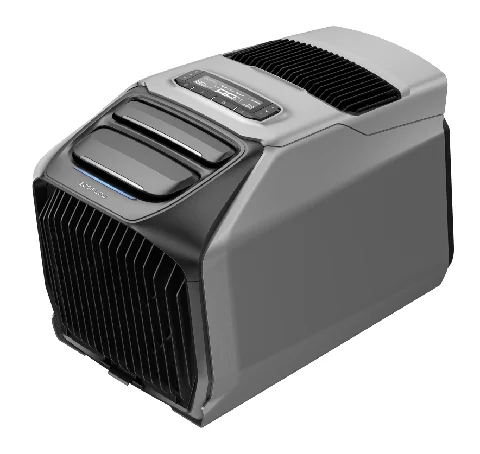
$849 at EcoFlow, read 2026-09-21
The higher-output battery AC, with one honest catch to read first. The WAVE 3 cools more than the Mark 3 and plugs into EcoFlow's DELTA power-station line, which makes powering an overnight easy. But it is NOT hose-free: to cool, it vents a hot-exhaust duct that has to leave the vehicle, and it's heavier at about 34 lb. In a car that duct still has to go out a window.
Skip it if: space and weight are tight — the smaller Mark 3 is easier to live with in a car.
Specs and pricing from EcoFlow's product page as of 2026-07-04; EcoFlow runs frequent flash sales, so treat the sale price as a snapshot.
$72 at Evapolar, read 2026-09-21
The realistic 'plug it in and cool me' pick for a dry-climate drive — but know exactly what it is. It's a small evaporative personal cooler that runs on USB power (a power bank or the car's USB port), blows air over a wet wick, and cools the space right in front of it. It truly needs no hose. The catch is the same as always: it cools by adding humidity, so it helps in dry desert air and does almost nothing in a humid cabin.
Skip it if: your climate is humid — evaporative cooling won't help there; ventilation and shade will do more.
Evaporative cooling adds humidity and fades fast in humid air — see the humidity section before buying.
A built-out van or RV changes everything, because you have house batteries, shore power, or a generator — enough to run a battery compressor AC for a full night. The Zero Breeze Mark 3 suits a compact van cabin; the EcoFlow WAVE 3 gives more output where you have the power for it; and the power stations above are how you run either while boondocking. Our camping guide covers the tent-and-van side in more depth.