Tent or van, off the grid
$1,269 at Renewable Outdoors, read 2026-09-21
Why this one
A battery compressor sized for 100–150 sq ft of tent or van — real cooling, no wall outlet. The reference camping AC.
A portable air conditioner for camping needs its own battery and a vent for hot air. No cheap box refrigerates a tent. Below: the battery units that really cool, the evaporative coolers for dry air, and what each costs to run.
Some links pay us a commission, at no cost to you. As an Amazon Associate, we earn from qualifying purchases. How we earn.
Tent or van, off the grid
$1,269 at Renewable Outdoors, read 2026-09-21
A battery compressor sized for 100–150 sq ft of tent or van — real cooling, no wall outlet. The reference camping AC.
Most cooling off-grid
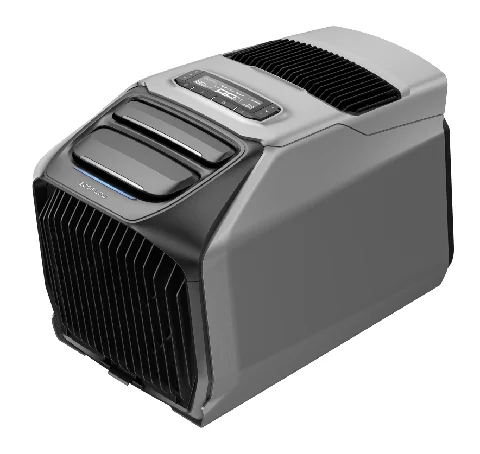
$849 at EcoFlow, read 2026-09-21
More BTU and a matching battery/power-station ecosystem. Still vents through a duct — not hose-free.
Just cool yourself, dry climate
$72 at Evapolar, read 2026-09-21
A truly hose-free personal cooler for a camp chair or cot — as long as the air is dry. Adds humidity.
Camping is where cooling marketing gets loudest and least honest, so start with the physics. A machine that refrigerates air — drops the actual temperature — moves heat from inside to outside and needs real electrical power to do it. In a tent that means two things every "camping AC" ad tends to skip: a battery big enough to run a compressor, and somewhere to vent the hot exhaust. The units that do this honestly are big, heavy and expensive. Anything small, cheap and "ventless" is either an evaporative cooler or a personal fan wearing a bigger word.
That leaves three real paths:
Below, the units honestly, then how to power them.
Four honest options across the three paths. Prices are what we saw on the dates shown — always confirm the live price before buying, because these move.
| Model | Type | Cooling | Coverage | Weight | Price | Where to buy |
|---|---|---|---|---|---|---|
| Zero Breeze Mark 3 | Battery compressor — dual-hose | 5,280 BTU | 100–150 sq ft (tent/van) | ~22 lb (unit) | $1,269 at Renewable Outdoors, read 2026-09-21 | |
| EcoFlow WAVE 3 | Battery compressor — vented | 6,100 BTU | — | 33.7 lb | $849 at EcoFlow, read 2026-09-21 | |
| Evapolar evaCHILL (EV-500) | Evaporative — truly hose-free | 340–1,190 BTU/hr | 21–27 sq ft, directly in front | — | $72 at Evapolar, read 2026-09-21 | |
| Hessaire MC18M | Evaporative — truly hose-free | 1,300 CFM airflow | Up to 500 sq ft (dry climates only) | 16 lb | price shown at the shop |
The EcoFlow WAVE 3 publishes no room-size rating, so we show none rather than invent one; the evaCHILL cools only the air directly in front of it. "Coverage" for the evaporative Hessaire applies to dry climates only.
A battery compressor AC will flatten a small power bank fast, and it will not run off a car's 12V socket. For a weekend you want a proper portable power station — a large LiFePO4 battery with a real inverter. EcoFlow's own WAVE 3 pairs with its battery add-on and its DELTA stations; the Zero Breeze Mark 3 pairs with its own 1,022 Wh add-on battery.
An honest limit: we will not print a runtime number ("X hours on a DELTA 3") that we can't verify against the manufacturer's own tested figure — real runtime depends on the temperature, the target setting and the battery's age, and a made-up hour count is exactly the kind of claim this site exists to avoid. What we can tell you is the station's capacity and output; match those against the AC's rated draw on its spec sheet, and treat any single "hours" figure you see online as optimistic.
| Model | Battery | Output | Expandable | Price | Where to buy |
|---|---|---|---|---|---|
| EcoFlow DELTA 3 | 1,024 Wh LiFePO4 | 1,800 W (3,600 W surge) | 1–5 kWh with extra batteries | $599 at EcoFlow, read 2026-09-21 | |
| BLUETTI AC180 | 1,152 Wh LiFePO4 | 1,800 W (2,700 W surge) | No — fixed 1,152 Wh | $499 at BLUETTI, read 2026-09-21 | |
| ALLPOWERS S2000 Pro | 1,451 Wh | 2,400 W pure sine | No — no expansion battery offered | $664 at ALLPOWERS, read 2026-09-21 | |
| EcoFlow DELTA 3 Max | 2,048 Wh LiFePO4 | 2,400 W | Up to 10,240 Wh | $879 at EcoFlow, read 2026-09-21 | |
| BLUETTI AC200L | 2,048 Wh LiFePO4 | 2,400 W (3,600 W surge) | Up to 8,192 Wh with B300 batteries | $899 at BLUETTI, read 2026-09-21 |
Three brands, two tiers and a middle. In the ~1 kWh class, BLUETTI's AC180 undercuts the EcoFlow DELTA 3 on both price and capacity — but it's a sealed unit, so the DELTA 3 is the one to buy if you want to add battery capacity later. In between sits the ALLPOWERS S2000 Pro: 1,451 Wh with the full 2,400 W output of the bigger stations at a mid-tier price — but like the AC180 it offers no expansion battery, so it's a buy-for-this-trip unit, not a system starter. In the ~2 kWh class the AC200L and the DELTA 3 Max are close on paper, and both expand toward whole-outage backup. For a tent AC on a hot night, more capacity beats more output — the compressor's surge is brief, the runtime is what runs out.
Those stations don't only run an AC. A 12 V fridge is the other thing worth powering off-grid in a heatwave — for cold water, and for any medication that has to stay refrigerated when the grid is down. A compressor model runs off any of the stations above; match its draw against the station's capacity the same way you would an AC.
| Model | Type | Capacity | Power | Price | Where to buy |
|---|---|---|---|---|---|
| Renogy 42 Qt Portable Refrigerator (40 L) | 12 V compressor fridge/freezer | 40 L (42 qt) | 12 V DC or AC adapter | $299.99 at Dr.Prepare, read 2026-09-21 |
Everything above assumes you're off-grid. But a lot of "camping" happens at powered sites — an RV park pedestal, a serviced campground, a cabin — and if you can plug in, the battery-AC math changes completely. A plain plug-in hosed portable AC costs a fraction of the battery route: a few hundred dollars against four figures for a battery AC plus its power station. The 8,000 BTU listing's window-seal-kit bundle was the same price as the bare unit when we checked (2026-07-13) — take the kit.
| Model | Type | Cooling | Price | Where to buy |
|---|---|---|---|---|
| Dr.Prepare 8000 BTU Smart WiFi Portable Air Conditioner | Single-hose portable AC (vents via window kit) | 8,000 BTU | $259.99 at Dr.Prepare, read 2026-08-23 |
Sold out — no active buy link (restock TBC)
|
It lists two BTU numbers, and the bigger one is the marketing one: 8,000 ASHRAE / 5,000 SACC, rated by Dr.Prepare for rooms up to 300 sq ft. SACC is the DOE seasonal rating and the honest one to size against. Verified from Dr.Prepare's product page 2026-07-26. (Dr.Prepare's 10,000 BTU model sat here until 2026-08-08, when they delisted it — we removed it rather than leave a dead link.)
The honest caveats: these are single-hose units that must vent hot exhaust outside — through an RV window or a cabin window with a seal kit, not through tent fabric — and they need real mains power, not a power station, to run all night. If your trips are genuinely off-grid, this section isn't your path; that's what the batteries above are for. For a sliding or crank-out window, the kit that comes in the box may not span the opening — see air conditioners for sliding and casement windows. To size either one against a real room, use the finder.
$1,269 at Renewable Outdoors, read 2026-09-21
The reference battery AC for camping. A genuine compressor rated by Zero Breeze for 100–150 sq ft — tent or van scale — running off its own 1,022 Wh battery pack, so no outlet and no power station required to start. It is a dual-hose unit, meaning it pulls its own intake and pushes exhaust: better sealing than single-hose, but two ducts to route out of the tent.
Skip it if: you're backpacking or counting ounces — nothing in this class is light, and a battery AC may simply be the wrong tool for the trip.
Base price seen at $1,269 (authorized reseller) and $1,299 (brand site, indirectly) as of 2026-07-04 — check the live price.
$849 at EcoFlow, read 2026-09-21
The higher-output off-grid choice, with one honest catch worth reading first. The WAVE 3 is a battery compressor with more cooling than the Mark 3 and a matching battery/DELTA ecosystem, which makes powering a long trip simpler. Critically, it is NOT hose-free: to actually cool, it vents hot exhaust through a duct that has to leave the tent. Only its dehumidify mode runs ductless, and dehumidifying is not cooling.
Skip it if: you want the smallest, tent-sized battery AC — the Mark 3 is lighter and purpose-sized for exactly that.
Specs and pricing from EcoFlow's product page as of 2026-07-04; EcoFlow runs frequent flash sales, so treat the sale price as a snapshot.
$72 at Evapolar, read 2026-09-21
Not an air conditioner — a small evaporative personal cooler, and honest about it. It blows air over a wet wick to cool the space directly in front of it, sips 7.5 W (a power bank can run it), and truly needs no hose. The hard catch: it works by adding moisture to the air, so it helps in dry desert camping and does almost nothing on a humid night — and in an already-damp tent it makes things clammier.
Skip it if: your nights are humid — evaporative cooling works against you there; a battery AC or just good airflow is the honest answer.
Evaporative cooling adds humidity and fades fast in humid air — see the humidity section before buying.
price shown at the shop
A bigger evaporative cooler for the campsite rather than the tent — the shaded picnic area, an open-sided canopy, a dry-camp awning. In genuinely dry air it moves a lot of cooled air for little power and refills from a garden hose. In humidity it does nothing useful, and it is a mains-powered unit, so you need shore power or a sizeable inverter — this is a dry-climate, powered-site tool, not a backcountry one.
Skip it if: you camp anywhere humid, or you need cooling inside a closed tent — evaporative outdoors won't deliver either.
Sold as MC18M / MC18MT (Ice Blue) / MC18V (Green) — same 1,300 CFM platform. Sylvane had the base MC18M at $189 in stock as of 2026-07-12; variant prices at other retailers still spread roughly $140–215.
If your campsite is in genuinely dry heat — the desert Southwest, the high plains — misting is a cheap way to cool an open, shaded spot the way the big Hessaire does, at a fraction of the size. The standing fan covers a picnic table or awning.
| Model | Type | Power | Price | Where to buy |
|---|---|---|---|---|
| Dr.Prepare Oscillating Standing Fan with Misting Kit | Oscillating pedestal fan with evaporative misting | AC mains | $45.99 at Dr.Prepare, read 2026-09-21 |
The same honest limit applies as to any evaporative tool: it cools by adding moisture, so it helps in dry air and does little in humidity — and it needs mains power and a water feed, which makes it a powered-site item, not a backcountry one.
Inside a closed tent, order of operations matters more than any gadget:
We don't publish "a tent runs X degrees hotter than outside" figures — the honest answer depends entirely on sun, color, fabric and ventilation, and a single number would be made up.
An RV or built-out van changes the math: you usually have house batteries, shore power at a hookup, or a generator, which makes a battery compressor AC far more practical to run for a full night. The same two units apply — the Zero Breeze Mark 3 for a compact van cabin, the EcoFlow WAVE 3 where you want more output and an easy battery ecosystem — and the power stations above are how you keep either running when you're boondocking without a hookup. Vent the exhaust out a window or roof vent, not into the living space.